
What these recommendations establish
This is research-based buying guidance, not our own treadmill testing. We matched current US models, manufacturer documentation and identifiable purchase routes. Incline figures are manufacturer-stated percentage grades, not angles in degrees or measurements we took. We have not established superior cushioning, noise, calorie burn or durability.
Maximum speed and maximum incline are separate specifications. In particular, we could not verify an exact-model grade-by-grade speed table for the X16. Do not assume that its two headline maximums are available together.[1][2]
Which incline treadmill should you buy?
Start with the hills you actually want the machine to provide. A steep trainer is a different purchase from a conventional folding treadmill that happens to have powered incline. If moderate uphill variation is enough, extreme grade capability may be a poor reason to accept a permanent, nonfolding installation. Our shortlist separates those buying decisions rather than ranking machines by the largest number alone.
Three incline options, three ownership choices
1. NordicTrack X16: when steep grades justify the space

Dedicated steep-grade choice
NordicTrack X16
22 × 60-inch belt · −6% decline to 40% incline · pivoting 16-inch touchscreen · 400 lb stated capacity · nonfolding design.[1]
Consider it when a conventional treadmill's hill range would not meet your intended use—not simply because the screen looks attractive.
The current US X16, hardware NTL29225, has the widest documented grade range on this shortlist. Its linked US manual is NTL29225.0. That exact-model match matters: instructions and operating limits from an older incline trainer are not automatically transferable.[1][2]
The ownership trade-off starts with placement. NordicTrack lists a 69.9 × 38.1-inch footprint, a 13.66-inch step-up specification and a nonfolding structure. The step-up number is not a verified maximum-incline deck height or a formula for your ceiling. Resolve overhead clearance for the tallest user at the intended grade before ordering.[1][2]
Who it suits
Buyers deliberately shopping for steep uphill/downhill variety who can dedicate a suitable room, plan delivery and evaluate the connected-content costs.
Who should skip it
People who need folded storage, an unresolved low-ceiling installation, or a guaranteed running speed at a particular steep grade. We did not verify that operating envelope.
Ownership trade-off: manual workouts are documented, but activation requires a free account and full connected features require paid iFIT Pro and Wi-Fi. The purchase flow we checked presented paid membership selections; we did not verify subscription-free checkout. Read the selected membership and renewal terms separately from manual-mode capability.[1][2]
Read our NordicTrack X16 review
Check price and availability at NordicTrack
2. Horizon 7.4 AT: powered hills without an integrated training screen
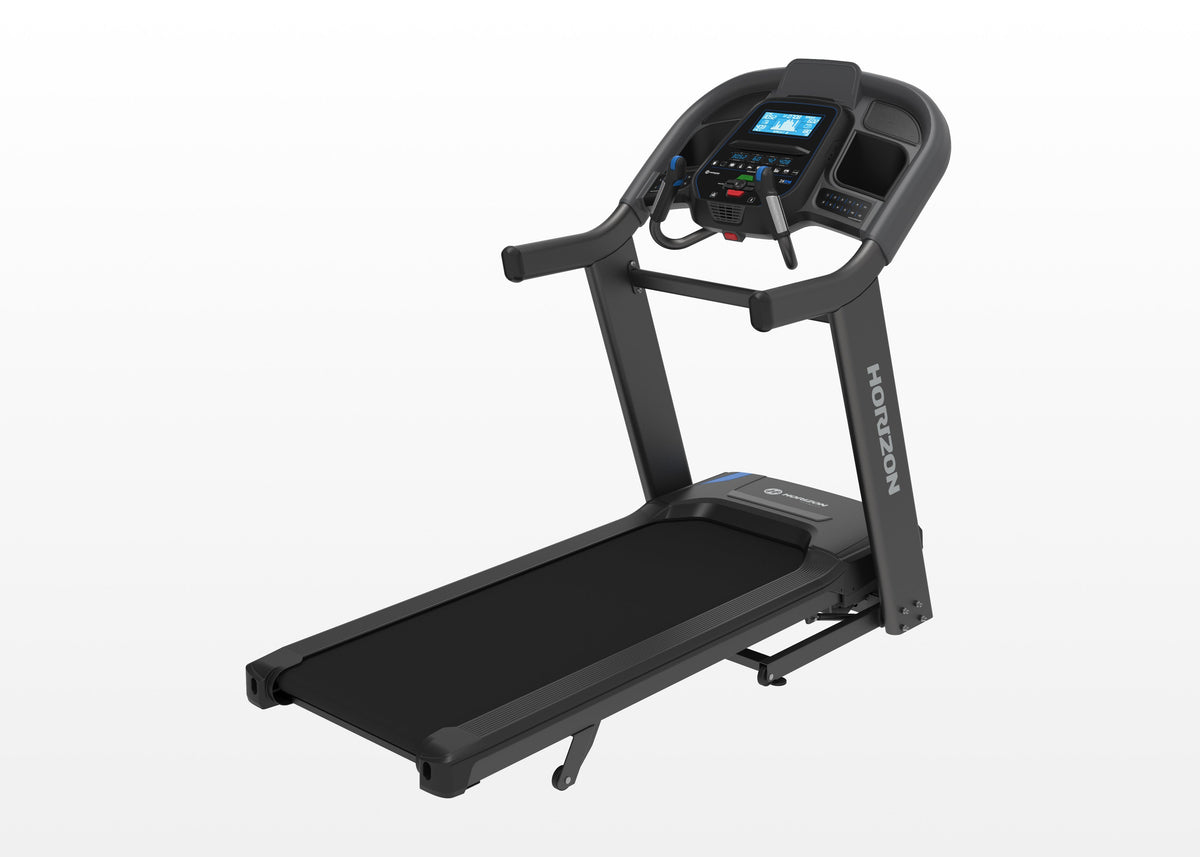
Folding, physical-control alternative
Horizon 7.4 AT
22 × 60-inch surface · 0–15% incline · QuickDial controls · conventional LCD/LED display · 350 lb stated capacity.[3][4]
A more relevant starting point when ordinary uphill sessions, standalone controls and your own entertainment device are the priorities.
The 7.4 AT offers a different ownership approach, not an equivalent steep range. The current official US SKU is HTM1380-01. Its physical controls and standalone programs let you choose optional apps separately; Bluetooth does not mean every app or device can control every function.[3]
Its incline starts at zero, so it is not the downhill option here. Folding also needs realistic interpretation: Horizon lists 318 lb machine weight and 42 × 37 × 71-inch folded dimensions. Plan a storage position and moving route rather than assuming folding makes relocation easy.[3][4]
Who it suits
Buyers who want powered uphill adjustment, physical controls, a full-size belt and freedom to bring their own screen or train without one.
Who should skip it
Anyone shopping specifically for decline, extreme steepness or a built-in coaching touchscreen. It is also not a lightweight folding pad.
Ownership trade-off: the stated warranty is lifetime frame and motor, five years for parts and two years labor, subject to the applicable terms. Check service availability, current dispatch timing and delivery tier. Our button goes to the exact current official model rather than older similarly named marketplace stock.[3][6][7]
Read our Horizon 7.4 AT review
Check price and availability at Horizon Fitness
3. NordicTrack Commercial 1750: connected coaching with folding storage

Connected incline-and-decline alternative
NordicTrack Commercial 1750
22 × 60-inch belt · −3% to 12% grade · pivoting 16-inch touchscreen · 400 lb stated capacity.[5]
Choose this training format for its integrated screen and folding layout, not as a substitute for a 40% incline trainer.
The current Commercial 1750, NTL17125, gives buyers uphill and downhill settings in a folding model. Its 77.3 × 37-inch operating footprint still needs a full-size room allocation; folded storage does not eliminate the space needed during use.[5]
Who it suits
Households wanting integrated iFIT coaching, a larger pivoting display and more moderate hills, with a planned operating position and usable folded storage.
Who should skip it
Buyers whose deciding requirement is steep hiking grade, or who would not use the paid connected experience. A screen alone is not a reason to accept its continuing costs.
Ownership trade-off: full iFIT features need paid Pro and Wi-Fi; activation also requires a free account. The linked Amazon offer is the reconciled one-month iFIT Pro bundle, not a promise of ongoing included membership. Confirm eligibility, renewal, seller and delivery arrangements.[5][9]
Read our Commercial 1750 review
Check price and availability on Amazon
What should you check beyond maximum incline?
The actual room: ask about deck height at your intended grade, not just overall frame height. The X16's manual requires eight feet behind and two feet on each side, beyond its footprint. Apply each exact model's own instructions rather than transferring that rule to every brand.[2]
The complete order: compare delivery, assembly, stair access, return freight, service coverage and paid-content renewals. Horizon separates standard delivery from room placement and assembly, and its return conditions can include freight and handling costs. Resolve those terms before treating an advertised trial as free removal.[7][8]
The actual user: the manufacturer limits are not our stability or durability findings. Stay within the applicable capacity, try the controls and intended pace where possible, and ask about any unresolved speed/grade combination. Do not choose a treadmill for a medical condition from an incline specification alone.
For broader choices, compare our running treadmill guide and folding treadmill guide. If the real task is desk walking, use the separate walking-pad guide rather than buying a large incline trainer for storage you do not have.
If upright walking matters more than steepness, compare our walking treadmill guide. For a lower item-price ceiling, see the separate under-$1,000 guide.
How we selected these incline treadmills
We separated steep-grade capability, physical-control folding use and connected incline/decline training. We matched exact US hardware to primary specifications, linked manuals, warranty terms and current purchase routes. All three have published standalone reviews. Fit judgments are editorial interpretations, not measured rankings; we do not award health, noise or reliability benefits from manufacturer marketing.
Frequently asked questions
Which pick has the steepest documented incline?
The X16 lists 40% incline and −6% decline. We have not measured those endpoints or verified its maximum speed at every grade.[1][2]
Is 40% necessary for ordinary uphill sessions?
That depends on your intended use. Compare the 7.4 AT's 0–15% range and the 1750's −3% to 12% range before accepting a dedicated steep trainer's room and ownership commitments.[3][5]
Which choice avoids an integrated paid-training screen?
The Horizon 7.4 AT uses physical controls and a conventional display; optional apps are separate. NordicTrack's connected features have their own subscription and account requirements.[1][3][5]
Do incline treadmills fold?
Some do. The Horizon and Commercial 1750 fold; the X16 does not. Compare both operating clearance and the actual folded dimensions.[1][3][5]
Can I calculate ceiling clearance from step-up height?
Not reliably from that figure alone. For the X16, we did not verify a maximum-incline ceiling formula. Ask the manufacturer about the tallest user's clearance at the intended grade, allowing for movement and fixtures.[1][2]
Does a 12 mph specification mean 12 mph at maximum incline?
Do not assume that combination. Our X16 review preserves the missing grade-specific speed table as an explicit limitation. Confirm a required pace/grade combination before purchasing.[1][2]
Sources used for this page
[1] https://www.nordictrack.com/product/x16-treadmill
[2] https://sfi.iconfitness.com/SalesForceInterface/download/file?fileName=NTL29225.0-454576.pdf&directory=%2Fpdf%2F
[3] https://www.horizonfitness.com/products/horizon-7-4-at-treadmill
[4] https://help.horizonfitness.com/hc/en-us/articles/53711698018452-Horizon-Fitness-7-4-AT-Treadmill-General-Information
[5] https://www.nordictrack.com/product/commercial-1750-treadmill
[6] https://help.horizonfitness.com/hc/en-us/articles/47020105286932-What-are-the-Standard-Manufacturer-s-Warranties-on-all-the-Machines
[7] https://www.horizonfitness.com/policies/shipping-policy
[8] https://www.horizonfitness.com/policies/refund-policy
[9] https://www.amazon.com/dp/B0GSH23JFC
As an Amazon Associate I earn from qualifying purchases. This page is based on documented specifications and attributed sources; Live Longer Running has not conducted hands-on testing of these products.